



Scientists at Texas A&M University have identified a significantly cheaper material that could help make future injectable glucose sensors more affordable for people living with diabetes.
In laboratory experiments, the alternative sensing ingredient delivered performance comparable to a material that costs approximately 10 times more, potentially opening a new direction for continuous blood sugar monitoring.
The discovery could eventually contribute to more accessible diabetes-monitoring technology, particularly for people who struggle with the recurring costs of conventional continuous glucose monitors (CGMs).
However, the experimental sensor has not yet been tested in humans and remains in the early stages of development.
The research, published in ACS Measurement Science AU, focuses on a nonenzymatic glucose-sensing platform that uses near-infrared (NIR) fluorescence to detect changes in glucose concentrations.
A Cheaper Ingredient Could Help Reduce Glucose Sensor Costs
Continuous glucose monitors have changed how many people manage diabetes by providing frequent information about blood sugar levels throughout the day.
Unlike traditional finger-prick testing, these wearable devices can help users identify glucose fluctuations and respond to changing levels.
However, the cost of monitoring supplies, replacement sensors, and insurance coverage can create financial challenges for some patients.
Researchers at Texas A&M are exploring an alternative approach that could eventually help address some of these affordability concerns.
The team compared two forms of a sugar compound called mannopentaose. Earlier versions of the sensing technology used α-mannopentaose, while the latest research investigated a less expensive alternative known as β-mannopentaose.
The researchers found that the β-form cost approximately one-tenth as much as its α-form counterpart while demonstrating comparable glucose-sensing performance under laboratory conditions.
This represents a substantial reduction in the cost of one important sensing ingredient, not a 90% reduction in the price of an entire glucose-monitoring device.
How Does the Experimental Injectable Glucose Sensor Work?
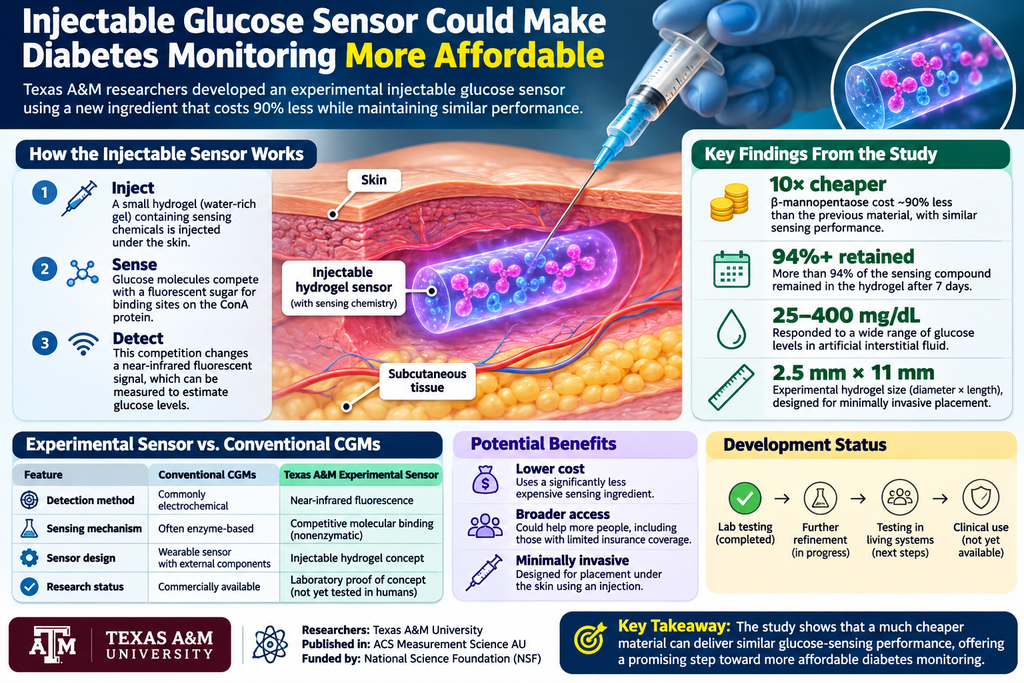
The technology uses a small, water-rich material called a hydrogel to hold the glucose-sensing chemicals beneath the skin.
The experimental design incorporates a fluorescent sugar compound, a specially modified protein called polyethylene glycol-conjugated concanavalin A (PEGylated-ConA), and a near-infrared fluorescent dye.
The sensing process relies on something known as competitive binding.
Under this mechanism, glucose molecules compete with fluorescent sugar molecules for available binding sites on the ConA protein.
When glucose concentrations increase, the balance between these molecules changes, producing a measurable change in the fluorescent signal.
Researchers can then use this optical response to estimate glucose concentrations.
Unlike many conventional electrochemical glucose-monitoring systems that rely on enzymes such as glucose oxidase, this experimental platform uses a nonenzymatic detection method.
The researchers also selected near-infrared fluorescence because this type of light has properties that may be useful for future optical measurements through biological tissue.
However, the team has not yet demonstrated through-skin optical glucose measurements using this particular device.
Laboratory Tests Show Encouraging Results
One of the most important findings involved the sensor’s ability to respond to different glucose concentrations.
The β-mannopentaose-based sensing system demonstrated a broad response range of approximately 25–400 milligrams per deciliter (mg/dL) in laboratory testing.
Researchers also evaluated the technology in artificial interstitial fluid, a laboratory solution designed to reproduce important characteristics of the fluid surrounding cells beneath the skin.
The experimental system demonstrated reproducible responses across low, normal, and elevated glucose ranges.
Another important development involved the hydrogel carrier.
The researchers incorporated the sensing solution into a small hollow hydrogel structure measuring approximately 2.5 millimeters in diameter and 11 millimeters in length.
The structure was designed to be compatible with minimally invasive placement beneath the skin.
Testing showed that more than 94% of the fluorescent sensing compound remained inside the hydrogel after seven days, with approximately 6% lost during the evaluation period.
This suggests that the hydrogel could provide a way to contain the sensing chemicals while allowing glucose to interact with them.
How Is This Different From Conventional Continuous Glucose Monitors?
Most commercially available CGMs use small sensors positioned beneath the skin to measure glucose in interstitial fluid. Many rely on electrochemical detection methods involving enzymes.
The Texas A&M approach explores a different sensing mechanism.
| Feature | Conventional CGMs | Experimental Texas A&M sensor |
|---|---|---|
| Detection approach | Commonly electrochemical | Near-infrared fluorescence |
| Sensing mechanism | Often enzyme-based | Competitive molecular binding |
| Sensor design | Wearable sensor with external components | Injectable hydrogel concept |
| Research status | Commercially available | Laboratory proof of concept |
| Long-term performance | Established for specific approved devices | Still under investigation |
The experimental approach could eventually offer another option for glucose monitoring, but researchers have not demonstrated that it is more accurate, longer-lasting, or more convenient than existing commercial devices.
Could This Make Diabetes Monitoring More Affordable?
The most immediate significance of the research is its focus on reducing the cost of individual sensing materials without substantially compromising laboratory performance.
If researchers can successfully develop the complete platform, a less expensive sensing ingredient could help reduce some manufacturing expenses.
The technology could also contribute to future minimally invasive glucose-monitoring systems that use optical signals rather than traditional enzyme-based detection.
For people with diabetes, more affordable monitoring options could eventually improve access to information that helps guide daily diabetes management.
However, the final manufacturing cost, retail price, insurance coverage, and potential savings for patients remain unknown.
Is the Injectable Glucose Sensor Ready for Human Use?
Despite the promising laboratory findings, the technology is not ready for clinical use.
The researchers have not demonstrated that the sensor can continuously monitor glucose inside a living human body.
The study also did not include through-skin optical measurements or testing in human participants.
Several important questions remain unanswered, including:
- How accurately will the sensor measure glucose inside living tissue?
- How long can the sensing chemistry remain stable beneath the skin?
- Will the device maintain reliable readings as glucose levels rise and fall repeatedly?
- Could inflammation, tissue reactions, or biological interference affect its performance?
- Can an external optical reader reliably detect the fluorescent signal through human skin?
The researchers have also identified future work involving improvements to the sensing architecture, signal stability, reversibility, and long-term performance.
The team plans to continue refining the platform and investigating additional components that could improve its practicality and longevity.
What Happens Next?
The findings offer an encouraging example of how researchers can approach the affordability challenge in diabetes technology by examining the cost and performance of individual materials.
The study was led by researchers including Sayantan Tripathy, Gérard L. Coté, and Melissa A. Grunlan at Texas A&M University.
The work received support from the National Science Foundation’s Engineering Research Center for Precise Advanced Technologies and Health Systems for Under-resourced Populations.
For now, people living with diabetes should continue using clinically approved glucose-monitoring devices recommended by their healthcare professionals rather than considering this experimental technology an alternative.
Although additional research is needed, identifying a sensing material that costs approximately 90% less while maintaining comparable laboratory performance represents a meaningful step toward developing potentially more affordable glucose-monitoring technologies.
Frequently Asked Questions
1. What is an injectable glucose sensor?
An injectable glucose sensor is an experimental monitoring technology designed to place glucose-sensing materials beneath the skin. The Texas A&M approach uses a hydrogel to contain fluorescent sensing chemicals.
2. How does the new diabetes sensor detect glucose?
It uses near-infrared fluorescence and competitive binding. Glucose molecules compete with fluorescent sugar molecules for binding sites on a protein called concanavalin A, changing the fluorescent signal.
3. Why is the new glucose-sensing material cheaper?
Researchers found that β-mannopentaose costs approximately one-tenth as much as the α-mannopentaose alternative used for comparison while providing comparable laboratory sensing performance.
4. Is the experimental glucose sensor better than current CGMs?
That has not been established. The research demonstrates promising laboratory results, but the experimental technology has not undergone human clinical testing.
5. When will the injectable glucose sensor become available?
There is no confirmed commercial release date. Additional research is needed to evaluate its accuracy, safety, long-term stability, and performance inside living tissue.
Sources & References: