



Researchers have developed an experimental electronic implant that could offer a new way to manage type 2 diabetes without relying on glucose-lowering drugs.
In tests involving diabetic mice, the device helped regulate blood sugar, reduced body weight and operated for six weeks without detectable tissue damage or other reported adverse effects.
The technology was developed by a research team led by Martin Fussenegger at ETH Zurich’s Department of Biosystems Science and Engineering in Basel, Switzerland.
The findings were published in the journal Science on October 22, 2026.
Unlike conventional treatments that influence how the body produces, uses or stores glucose, the experimental system takes a different approach: It uses an electrically powered catalyst to convert excess glucose into another substance that can be eliminated through urine.
The results offer an early glimpse of how electronic medical devices could eventually complement existing approaches to managing diabetes.
However, the research remains at the preclinical stage, and its safety and effectiveness in humans are unknown.
How Does the Experimental Diabetes Implant Work?
The device uses a process called electrocatalysis, in which electrical energy helps drive a chemical reaction.
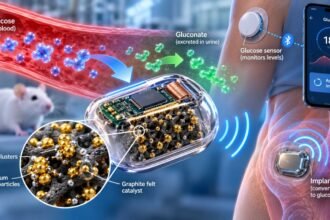
Its catalyst is made from graphite felt containing gold nanoclusters decorated with extremely small platinum particles.
According to the researchers, this inorganic construction does not require living cells, enzymes or other biological components to carry out its glucose-conversion function.
The implant also contains an electronic control unit housed in a 3D-printed casing.
It receives power wirelessly at 13.56 MHz, a frequency used for industrial, scientific and medical applications.
The catalyst converts glucose into gluconate.
Unlike glucose, which the body can use for energy or store, gluconate can be eliminated through the kidneys and excreted in urine.
By redirecting some excess glucose through this pathway, the system aims to lower the amount of glucose available for normal metabolic processing.
The researchers are also investigating its potential to address obesity associated with type 2 diabetes, sometimes described as diabesity.
This mechanism differs from conventional diabetes treatments, which may improve insulin sensitivity, stimulate insulin secretion, reduce glucose production by the liver or replace insufficient insulin.
The experimental implant instead attempts to remove a portion of excess glucose through a controlled chemical process.
Also See: Retatrutide Reduced Sleep Apnea Severity in Two Phase 3 Clinical Trials
A Glucose Sensor Helps Control the Device Automatically
One of the system’s key features is its closed-loop control mechanism, designed to activate the catalyst only when glucose levels rise above the desired range.
The system works alongside a glucose-monitoring sensor, similar to the continuous glucose monitors commonly worn on the upper arm by people with diabetes.
When the sensor detects elevated glucose, it sends information through Bluetooth to a smartphone or smartwatch.
The smart device then activates the implant’s catalyst, which uses electrical energy to convert glucose into gluconate.
When glucose levels return to the target range, the system switches the catalyst off automatically.
This feedback-based approach is intended to limit unnecessary glucose conversion and reduce the risk of excessive glucose lowering.
Nevertheless, the device’s ability to prevent dangerous glucose fluctuations will need to be established through further testing.
What Did the Study Find?
The research team first tested the catalyst in a five-liter reservoir containing a glucose-rich nutrient solution, approximately comparable in volume to the blood in an adult human body.
The experiment demonstrated that the system could convert glucose within that volume of solution.
The researchers then evaluated the technology in diabetic mice.
According to the published study and ETH Zurich’s research announcement, the main findings included:
- Blood sugar regulation: The device helped restore glucose balance in diabetic mice.
- Weight reduction: The treated animals lost body weight during the experimental period.
- Six-week operation: The implant functioned reliably throughout the reported treatment period.
- Tolerability: Researchers reported no detectable hypoglycemia or adverse physiological, inflammatory or behavioral effects during the study.
- No detected tissue damage: The experiments found no evidence of tissue damage caused by electrical or thermal effects.
The study also reported changes in metabolism, including increased circulating free fatty acids and ketone bodies, consistent with a shift toward greater use of fats as an energy source.
These results are encouraging, but they must be interpreted in the context of an animal study.
Six weeks of testing cannot establish whether an implanted device would remain safe over months or years, and findings in mice do not necessarily predict outcomes in humans.
Could the Implant Replace Diabetes Medication?
Not at this stage.
The research suggests a possible alternative mechanism for controlling excess glucose, but it does not demonstrate that the implant can replace insulin, metformin, GLP-1 medications or other established diabetes treatments in people.
Type 2 diabetes is a complex metabolic condition involving varying degrees of insulin resistance, impaired insulin secretion and other physiological changes.
Controlling blood glucose is an important part of treatment, but managing the condition may also require attention to cardiovascular health, kidney function, weight and other risk factors.
The experimental implant has not yet undergone human clinical testing.
Researchers must establish whether it can work safely in the human body, how much glucose it can process, how long the catalyst remains effective and whether the body tolerates the implant over extended periods.
Potential practical challenges also need evaluation, including infection or inflammation around the implant, device malfunction, long-term material stability and the effects of sustained glucose conversion.
Consequently, the technology should be viewed as a potential future treatment approach rather than an available drug-free solution for diabetes.
What Happens Next?
The ETH Zurich team plans to develop the experimental system into a medical device.
The researchers believe that using an inorganic catalyst rather than living cells or enzymes could simplify some aspects of engineering and manufacturing.
Existing technologies for glucose monitoring, electronic control and wireless power transmission may also support further development.
If subsequent studies demonstrate that the system is safe and effective in humans, it could eventually provide another option for managing excess glucose, potentially alongside other diabetes treatments.
However, its clinical role, eligibility requirements, cost and regulatory pathway remain undetermined.
For now, the study represents a promising development in experimental diabetes technology – not a cure.
People living with diabetes should continue their prescribed treatments and consult their healthcare professionals before making any changes to medication or glucose-management plans.
Research Source
Maity D, Guha Ray P, Buchmann P, Charpin-El-Hamri G, Fussenegger M. “Wireless electrocatalytic closed-loop system for drug-free management of diabesity.” Science. 2026;394(6822). Published October 22, 2026.
Original research: https://doi.org/10.1126/science.ady8560
Research announcement: https://bsse.ethz.ch/news-and-events/d-bsse-news/2026/10/tackling-diabetes-with-an-electronic-implant-how-a-tiny-catalyst-lowers-blood-sugar.html
Editorial note: This article reports experimental research and is intended for informational purposes. The implant has not been tested in humans.