
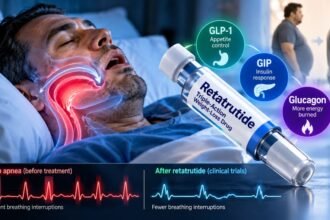



An experimental weight-loss medication has shown promising results against obstructive sleep apnea, reducing nighttime breathing interruptions in two late-stage clinical trials involving adults with obesity or excess weight.
The findings, published October 20 in the New England Journal of Medicine, suggest that retatrutide may offer another potential treatment option for people whose sleep apnea is linked to excess body weight.
However, the drug remains investigational and is not approved for public use. Read the original study.
Retatrutide Improved Sleep Apnea in Both Trials
Researchers evaluated retatrutide in two phase 3 trials involving adults with moderate-to-severe obstructive sleep apnea (OSA).
The TRIUMPH-1-OSA trial included participants without type 2 diabetes, while TRIUMPH-2-OSA enrolled people with the condition.
Participants received once-weekly injections of retatrutide at doses of 4 mg, 9 mg, or 12 mg, or a placebo.
The researchers measured changes in the apnea-hypopnea index (AHI), which records the average number of breathing interruptions per hour of sleep.
After 80 weeks, retatrutide reduced AHI more than placebo across all tested doses.
In participants without diabetes, the average AHI reduction ranged from approximately 23 to 34 events per hour, depending on the dose, compared with about 10 events per hour with placebo.
Among participants with diabetes, reductions ranged from approximately 19 to 25 events per hour, compared with about 10 with placebo.
At the higher doses, 39% to 52% of participants across the reported trial populations reached mild or no sleep apnea without excessive daytime sleepiness, compared with approximately 13% receiving placebo.
Also See: New Study Finds Eating One Avocado Every Day May Lower Bad Cholesterol and Reduce Heart Disease Risk
Weight Loss May Help Explain the Results
Retatrutide also produced substantial weight loss. Participants without diabetes lost an average of approximately 12.5% to 22.2% of their body weight, while those with type 2 diabetes lost approximately 12.1% to 18.5%.
Placebo groups recorded smaller average reductions.
Developed by Eli Lilly, retatrutide activates three hormone receptors: GLP-1, GIP, and glucagon.
This triple-action mechanism influences appetite, blood sugar regulation, and energy metabolism.
Excess weight can contribute to airway narrowing during sleep. Reducing body weight may therefore improve breathing, although individual results vary.
Could Retatrutide Replace CPAP Treatment?
Continuous positive airway pressure (CPAP) remains an established treatment for sleep apnea.
Some patients find the equipment difficult to tolerate, making additional treatment options valuable.
Importantly, the FDA approved tirzepatide, sold as Zepbound, in December 2024 for certain adults with obesity and moderate-to-severe OSA, alongside reduced-calorie eating and increased physical activity.
Retatrutide’s results are promising, but researchers must continue evaluating its safety and effectiveness.
Gastrointestinal problems were among the most common adverse events reported in the trials.
What happens next? Regulatory review would be required before retatrutide could become an approved treatment. Patients should continue prescribed sleep apnea therapy unless their healthcare professional advises otherwise.